
How to Plan a Long-Haul Flight with Children (Without Dreading It)

The destination is rarely the thing that stops families booking the bigger trip. It’s the flight. Ten hours in a metal tube with a toddler is a genuinely intimidating prospect, and it’s the reason a lot of families default to the same short-haul beach every year.
But long-haul with children is very doable — the difference between a good flight and a grim one is almost entirely in the planning. Here’s how to think about it.

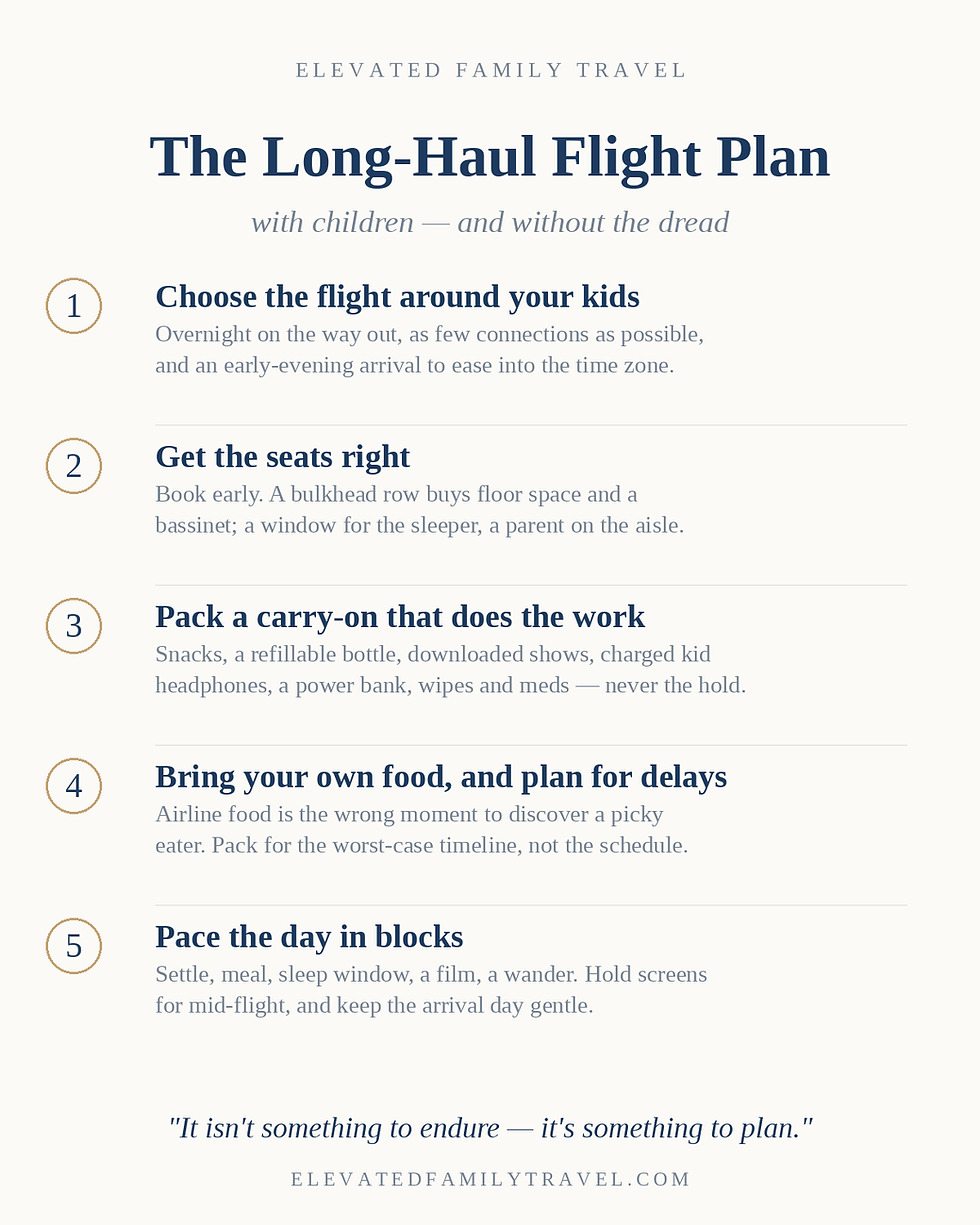
Choose the flight around your children, not the price
This is the one place where the cheapest option is usually a false economy. A few principles:
Overnight flights are your friend on the way out. If the flight covers your children’s normal sleep hours, they’ll sleep through a large chunk of it. A daytime long-haul with an overtired child is a much harder day.
Fewer connections beats a slightly cheaper routing. Every transfer is another chance for delays, meltdowns and lost buggies. Direct is worth paying for.
Mind the arrival time. Landing in the early evening local time lets you get to the hotel, have dinner and sleep — the gentlest way to start adjusting to a new time zone.
Get the seats right
Book seats as early as you can and think about the configuration, not just “together.” For younger children, a bulkhead row often gives more floor space and, on many airlines, a bassinet for babies. Consider a window seat for the child who’ll sleep leaning against it, and put a parent on the aisle for the inevitable bathroom trips. If it’s within budget, premium economy on a long overnight is one of the higher-value upgrades in family travel — the extra recline and space translate directly into sleep.
Pack a hand-luggage kit that does the heavy lifting
Your carry-on is your toolkit for the whole flight. The essentials:
A change of clothes for each child (and a spare top for you).
More snacks than you think you need — familiar ones.
A refillable water bottle, filled after security.
Downloaded shows and a pair of kid-sized headphones, charged, plus a power bank.
A small bag of new, cheap novelties — stickers, a new small toy, a fresh colouring book — rationed out across the flight. Novelty buys you time.
Wipes, nappies/pull-ups if relevant, and any medication in your hand luggage, never the hold.
Bring your own food — and pack for delays
A lot of children are picky eaters, and airline food is exactly the wrong moment to discover that. The meal arrives at an odd hour, it looks unfamiliar, and a hungry, tired child on a plane is a problem you can’t easily solve at 38,000 feet. So don’t rely on the tray. Bring the snacks your children actually eat — the ones you know they’ll reach for without a negotiation — and enough of them to cover a proper meal, not just nibbles.
Then pack as if the day is going to be longer than the schedule promises. Delays are routine on long-haul: a late boarding, a hold on the tarmac, a slow bag carousel, a missed connection. Plan your food and drink around the worst-case timeline, not the best one, so a two-hour delay is an inconvenience rather than a meltdown. Extra snacks weigh almost nothing and buy you an enormous amount of calm.
Bring your own headphones and the right adapter
The headphones handed out on planes are usually poor quality and rarely fit small heads, and the volume-limited kid’s pair you have at home will always be better. Pack your children’s own headphones — and, crucially, check what they’ll plug into. Many seatback systems still use a twin-pin socket or an ordinary headphone jack, while your child’s headphones may be wireless or USB-C. A cheap adapter (twin-pin to 3.5mm, or the connector your kit needs) is the difference between the in-flight screen working and a child staring at a film they can’t hear.
Match the entertainment to the age
Entertainment is where flights are won or lost, and younger children need a lot more of it. For toddlers and little ones, choose things that are genuinely plane-proof: no tiny pieces that vanish under the seat in front, and nothing that falls apart the moment there’s turbulence. Think chunky, self-contained, quiet toys, sticker books, reusable activity pads — items that survive being dropped, jostled and picked up a hundred times.
Older children are much easier: let them choose their own activities to bring. A book, a drawing kit, a downloaded game, whatever holds their attention — the fact that they picked it makes them more likely to stay with it. Giving them ownership of their own bag also frees you up to focus on the younger ones who need managing.
Manage the day itself with pacing
Think of the flight in blocks rather than as one endless stretch: settling in, a meal, a sleep window, a film, a wander down the aisle to stretch. Keep screen time as a mid-flight tool rather than firing it up before takeoff — you’ll want that card to play later. Encourage drinking and swallowing during descent (a snack or drink) to help little ears. And accept in advance that there may be a difficult twenty minutes. There usually is, and it passes.
Comfort matters on a long flight in economy
If you’re doing a long haul in economy, comfort is the thing that determines whether your children sleep or spend the night fidgeting and fractious. Bring whatever they need to actually settle: their own light blanket or a large soft scarf, a familiar small pillow or a travel neck pillow sized for a child, cosy socks for feet that get cold, loose comfortable layers to change into, and the one comforter — the toy, the blanket, the thing — they can’t sleep without. None of it takes much space, and a child who feels tucked-in and cosy is a child far more likely to drift off.
The first day at the destination
Don’t schedule anything ambitious for the arrival day or the morning after. Sunlight, a gentle walk, an early dinner and an early night do more for jet lag than any trick. Let the kids find their rhythm before you start exploring properly. This is the whole philosophy in miniature: build in the downtime, and the trip stays restorative instead of turning into an endurance event.
Long-haul with children isn’t something to endure — it’s just something to plan. Get the flight timing, the seats, the kit and the pacing right, and the distance stops being the thing that decides where your family can go.

Comments